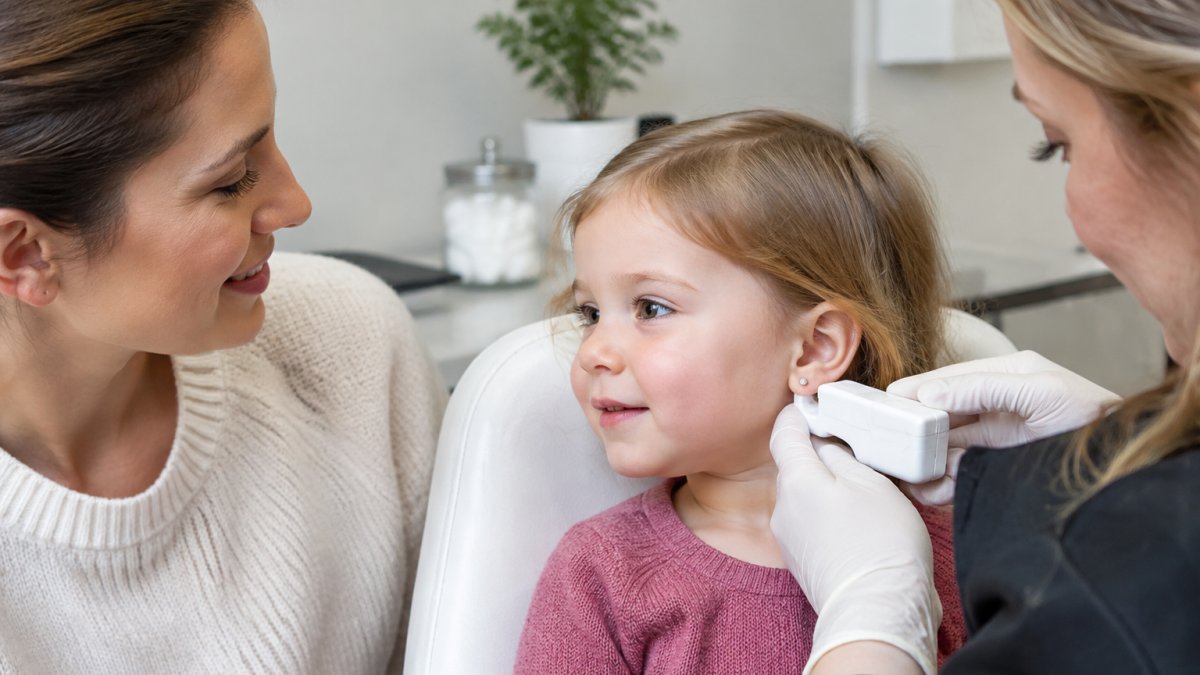
 Ultimate guide
What Is the Best Age for Baby Ear Piercing?
Last Updated: November 22, 2026
Quick Summary
There is no federal law or national medical standard setting a minimum age for baby ear piercing, so recommendations range from 6-8 weeks to waiting until the child can ask. Most guidance settles between 2-3 months and after first vaccinations, with the exact month mattering less than sterile technique and consistent aftercare.
- Many professional piercers recommend 2-3 months, when the earlobe holds a starter stud securely.
- Some pediatric clinicians prefer 6 months, citing a larger earlobe and lower embedding risk.
- Clean the piercing twice a day for six to eight weeks and check the backs daily.
- Starter earrings should be implant-grade titanium, niobium, or surgical stainless steel, never nickel.
- Delay piercing if your child is sick or has an active skin infection or rash near the ear.
Table of Contents
- What Age Is Safe to Pierce a Baby's Ears? Comparing Recommendations
- Reasons Parents Choose to Pierce a Baby's Ears Early
- Reasons to Wait Until a Child Is Older
- Pediatrician Guidance and Medical Considerations
- Pain, Discomfort, and How a Baby Responds
- Vaccination Timing and Eligibility
- Choosing a Qualified Piercer and Safe Piercing Methods
- How Long Does Baby Ear Piercing Take to Heal?
- How to Care for Baby Ear Piercing: Daily Aftercare by Age
- When to Postpone Piercing and Warning Signs to Watch For
- Frequently Asked Questions
What Age Is Safe to Pierce a Baby's Ears? Comparing Recommendations
There is no federal law or national medical standard that sets a minimum age for ear piercing in the United States, and no major pediatric organization issues a mandatory threshold. That is why a parent can search the same question and find answers ranging from "six weeks" to "wait until she asks." The recommendations are not contradictory so much as built on different priorities. Understanding what each camp is optimizing for makes the conflicting advice much easier to sort through. (Source: Centers for Disease Control and Prevention immunization schedules)
The Common Thresholds, Side by Side
| Recommended Age | Who Typically Says It | What It Optimizes For | What It Leaves Out |
|---|---|---|---|
| 6-8 weeks | Some piercing studios and family tradition | Early healing while the baby is still easy to hold still; first vaccinations begun | Does not account for individual immune or skin history |
| 2-3 months | Many professional piercers | Earlobe has enough tissue to hold a starter stud securely; vaccination series underway | Still requires weeks of diligent aftercare from a caregiver |
| 6 months | Some pediatric clinicians | Larger earlobe, lower risk of the backing embedding, more robust immune response | Baby is now mobile and more likely to tug at jewelry |
| After first vaccinations | Pediatricians focused on immune readiness | Reduces the chance of piercing during or right after an illness | Does not address mechanical risks like snagging |
| When the child can ask | Many pediatricians and child-development advocates | Child assent, easier aftercare, lower removal rate | Older children may face school rules or sports restrictions |
Why the Guidance Diverges
A pediatrician and a piercer are answering slightly different questions. The clinician is weighing infection risk, immune development, and the chance that a minor wound heals poorly in a baby who is already fighting something off. The piercer is weighing anatomy and mechanics: whether the earlobe is thick enough that a starter earring will not migrate or embed, and whether the backing will stay secure on a growing ear. A parent is usually weighing pain, convenience, and family meaning. None of those frameworks is wrong, but each produces a different number.
A common pattern is that advice tightens as the stakes rise. Practitioners who have seen embedded earrings or stubborn infections tend to recommend waiting longer; practitioners who have seen thousands of uncomplicated infant piercings tend to be comfortable earlier. The variation is a feature of professional judgment, not a sign that one source is careless.
What the Variation Means for Your Decision
Rather than hunting for the single correct age, treat the range as a set of conditions to check. The lower bound is usually set by vaccination status and general health; the upper bound is set by the child's ability to leave the jewelry alone. If your baby is healthy, current on the recommended immunization schedule, and you can commit to cleaning twice a day for six to eight weeks, the exact month matters less than the technique and aftercare that follow. If any of those conditions is missing, the later recommendation is the safer one.
Watch out: a recommendation that sounds authoritative may simply reflect one practitioner's experience. Ask any piercer why they use their minimum age, and ask your pediatrician whether anything in your child's health history argues for waiting.
Reasons Parents Choose to Pierce a Baby's Ears Early
Many families pierce early for cultural, family, or practical reasons: the tradition is meaningful to them, and a young infant cannot tug at the earrings or ask to remove them. Healing can also be simpler to supervise, because a baby is not yet running through playground equipment that catches on jewelry. For parents weighing this choice, the deciding factor is usually whether they can commit to weeks of consistent cleaning.
Reasons to Wait Until a Child Is Older
Waiting has real advantages. An older child can tell you if the site hurts, understands not to touch it, and can take part in cleaning. A common mistake is piercing during a busy season, travel, or illness, when aftercare gets skipped. If a child is old enough to express a preference, their willingness matters; a piercing done against a child's wishes usually ends in removal.
Pediatrician Guidance and Medical Considerations
A pediatrician can confirm your child is healthy enough for a piercing and up to date on recommended vaccines, and can flag conditions that warrant delay. A baby ear piercing is a minor puncture wound, and like any wound it heals best in a healthy child. Ask your pediatrician about timing around vaccinations and about any skin sensitivity or allergy history. For parents with specific safety and aftercare questions, our baby piercing information and Q&A covers what to expect from a professional service.
Pain, Discomfort, and How a Baby Responds
The piercing itself is brief, and most babies cry for a short moment before settling. Discomfort afterward is usually mild: some redness and tenderness around the earlobe for a day or two is common. A baby's response varies widely, and a calm, unhurried setting helps. Watch for crying that does not settle, or swelling that worsens rather than eases, and contact a clinician if either occurs.
Vaccination Timing and Eligibility
Timing a piercing around the infant vaccination schedule is a reasonable question. The DTaP vaccine, which protects against diphtheria, tetanus, and pertussis, is given in a series starting in early infancy according to the CDC immunization schedule. Ask your pediatrician whether your baby is current before scheduling, and avoid piercing during or right after an illness, when the body is already working hard.
Choosing a Qualified Piercer and Safe Piercing Methods
The single biggest safety decision is not the age, it is who does the piercing and how. Parents can ask questions of an expert in baby piercing before booking. A skilled practitioner with sterile technique and appropriate jewelry is an important part of a safe outcome at any age. Readers can see other parents' experiences with this piercer. The challenge is that piercing is lightly regulated in most states, so parents have to do the vetting themselves.
What to Verify Before You Book
- Sterile, single-use equipment. Ask directly whether the needle and jewelry come out of sealed sterile packaging opened in front of you.
- Credentials and training. Look for a piercer with current bloodborne-pathogen training and first-aid certification. Membership in a professional piercing organization is a useful signal, though not a guarantee.
- Jewelry material. Starter earrings should be implant-grade titanium, niobium, or surgical stainless steel. Nickel is the most common cause of allergic reaction, so avoid unclear "hypoallergenic" claims and ask for the specific alloy.
- Backing style. Screw-back or flat-back studs resist snagging and embedding better than butterfly backs on a baby's small earlobe.
- Studio environment. Clean surfaces, gloves changed between steps, and a hand-washing sink in the piercing area are baseline expectations.
Piercing Guns vs. Needles: The Real Trade-offs
Piercing guns are common at mall kiosks and some pediatric offices, but they work by forcing a blunt stud through the tissue rather than slicing a clean channel. Hollow needles, by contrast, create a clean opening and allow the piercer to control depth and angle. Many experienced practitioners prefer a needle for these reasons.
Method and Aftercare by Age
The technique that works best shifts with the child. Infants are easiest to pierce while feeding or drowsy, when they are still and comforted; a two-person team, one to hold and soothe, one to pierce, is common. Toddlers need a calm, quick appointment with minimal waiting, because a tired or frightened toddler is harder to position safely. Older children benefit from being told what will happen and from practicing the cleaning routine beforehand, which makes them partners in aftercare rather than surprised patients.
Watch out: a studio that will not answer questions about sterilization, jewelry alloy, or needle type before you arrive is telling you something. It is reasonable to walk away and book elsewhere.
How Long Does Baby Ear Piercing Take to Heal?
Baby ear piercings generally take several weeks to heal, and every child heals at their own pace. During that window the site needs daily cleaning and protection from snagging. Cartilage piercings take considerably longer, which is one reason earlobes are the standard choice for young children. Do not remove starter earrings before healing is complete, since the hole can close quickly.
How to Care for Baby Ear Piercing: Daily Aftercare by Age
Consistent cleaning is what protects the piercing. Wash hands first, then clean the front and back of the earlobe gently with the solution your piercer recommends, and rotate the earring only as instructed. Check the backs daily for tightness and for any sign of embedding in the skin.
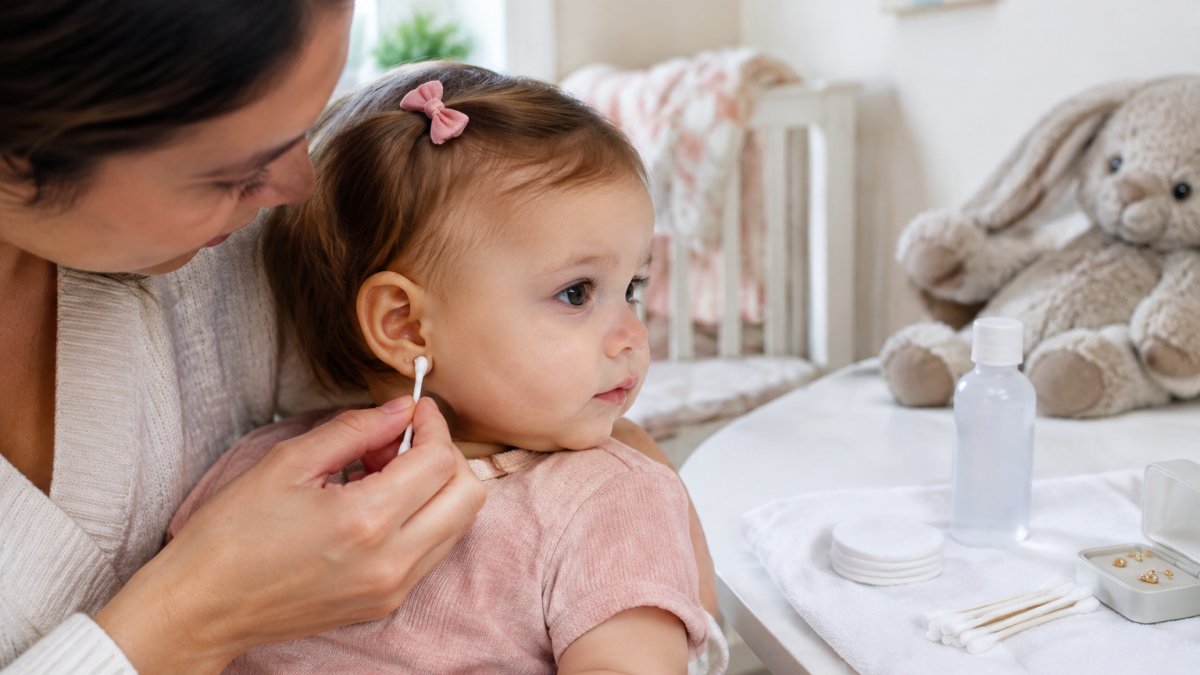
- Infants: clean during a calm moment, keep the site dry after baths, and check backs at every diaper change.
- Toddlers: clean twice daily, watch for snagging during play, and dress them in clothing that clears the ears.
- Older children: let them help with cleaning so the routine becomes a habit.
When to Postpone Piercing and Warning Signs to Watch For
Delay the piercing if your child is sick, has an active skin infection or rash near the ear, or has a known metal allergy that has not been evaluated. After piercing, seek medical advice for spreading redness, warmth, pus, fever, or an earring back that has sunk into the skin. Watch out: a swollen earlobe that swallows the earring back can become an embedded earring, which needs prompt professional removal. If anything concerns you, contact us directly so we can advise on next steps.
Deciding when to pierce is a judgment call, and we would rather you ask questions than guess. At babypiercing.com, our family-owned clinic brings more than 35 years of medical expertise to every appointment, using secure screw-back earrings designed for younger clients and a sterile, unhurried setting for infants through adults. Get started with babypiercing.com and schedule a calm, professional first piercing for your child.
Frequently Asked Questions
What age is best to get babies' ears pierced?
There is no single best age. Many parents choose between 2 and 6 months, when babies are less mobile and earrings are easier to keep clean. Others wait until a child is old enough to ask for the piercing and help with aftercare, often around age 7 or older. Pediatric guidance varies, so discuss timing with your child's doctor and weigh healing, infection risk, and your child's readiness.
What is the 3/2 rule for ear piercings?
The 3/2 rule is a common aftercare guideline: clean the piercing three times a day for the first two weeks, then twice a day until healed. It is not an official medical standard, but many piercers use it to build a simple routine. Always follow the specific care instructions from your piercer and pediatrician, and check the piercing daily for redness, swelling, or irritation.
How long does baby ear piercing take to heal?
Earlobe piercings in babies and young children generally take several weeks to heal, though some take longer. Cartilage piercings heal more slowly. Keep starter earrings in place for the full healing period and clean the site as directed. If redness, swelling, or discharge persists, contact your child's healthcare professional.
When can I change my baby's first ear piercing?
Wait until the piercing is fully healed, usually at least 6 to 8 weeks for earlobes, before changing earrings. Changing too soon can irritate the healing tract and raise infection risk. When you do switch, choose hypoallergenic jewelry with secure backs, and have a professional help if the earring feels stuck or the hole looks irritated.
What should parents ask before getting a baby's ears pierced?
Ask how the studio sterilizes equipment, whether staff are trained in infant piercing, what jewelry is used (nickel-free and secure screw backs are preferred), and what aftercare instructions they provide. Confirm the piercing method and whether a healthcare professional is involved. Also ask about follow-up care and what to do if signs of infection appear.
How should parents care for a baby's new ear piercings?
Clean the earlobes gently with the cleanser your piercer recommends, usually twice a day, and keep the area dry. Avoid touching the earrings with dirty hands, and do not twist or rotate them. Check daily for redness, swelling, or snagging, and keep hair and clothing away from the piercing. Contact a healthcare professional if irritation or signs of infection develop.
